Showing posts with label analysis. Show all posts

Saturday, 19 September 2015

Month in Online Merchandising : September

Seasalt Bowline Jacket £140, Des Petites Hauts Bibli Cardigan €159, Clarks Orla Andie Boots £180, Sambonet Terra Cotto Saucepot £52 at Heals, Wild & Wolf Enamel Bowls £27.50 at Baltic Shop, John Lewis Nordic Carafe £12 and Tumblers £4 each

It's September and already all-go with us. Here are my 'undo-able' to-dos for the month:

As we start to build up to the month of December, I've a long list of pages to optimise. I'm starting with really key pages now: pages of products that are integral to customers festive activities. Depending on what industry you're in that could be gifts, items for entertaining, decorations, party-wear... Then, I'll do some more tangential pages and return to core areas in a month or so, to make them fresh and even more relevant, and to look after any new products.
This year, I already have the end of December at the back of my mind as well - how pages can be adapted to meet the very different demands of the Winter sales period.


I haven't managed to make much progress on my compendium of great merchandising ideas - I think I need to set aside an hour or two each week for recording anything I've spotted, browsing for more examples etc...

We are wanting to review our 'review processes' soon too: take a look at what it is we currently esteem to be a success and how we measure degrees of success. Merchandising can achieve lots and lots of different things - improving sales, improving product views (and I say improving not increasing because sometimes you might not be going after volumes), increasing profit, creating a particular aesthetic-impression (one consistent with bricks-and-mortar stores, for example)... And you can measure in lots of different ways - you can consider individual products, you can consider pages as a whole, you can consider areas of pages (e.g. the effect generated by the first three rows, or the top right-hand product).
The processes we have in place now are good, but it's important consider other options or improvements.

Well, have a lovely week. I'm hoping to write some more about the first of my to-dos - to give a bit of an insight into how I'm thinking when I'm merchandising at the moment - so hopefully, it won't be too long before I post again.


Mari x

Friday, 8 May 2015

Taking a merchandising-approach to content focussed pages


Marimekko Hyhy Bracelet Jarrolds £29, Flower Tote Orla Kiely Bag £269, Peep Shoe Office £35, Maisie Dress Wrap London £159, Macrame Earrings Toast £45, Filet a Provisions Merci-merci.com €10, Covered Strap Sandals Swedish Hasbeens £155

I've been working - not in product galleries, where I usually work - but on department, or category, pages recently. In my vocabulary, department pages are pages containing links to product galleries, content, and a few, well-selected products. For a grocer, 'dairy' might be a department page. It would link to milk, butter, yogurt...; it might tell a story about a supplier, or give a recipe for Arctic roll; and some specialty cheeses might be featured.

It's been very interesting applying my usual ways of working to a different area - seeing where they were sufficient, where they were lacking. I naturally found myself considering clicks and sales, and comparing to similar pages on our site and on competitors' sites. My colleagues suggested I look at the evolution of the page over the last few years and search data from various sources, and also that I speak to other functions dealing with this department (customer services to be aware of common customer queries, etc). It's definitely taught me things to take back to my galleries.

I was keen to learn more, so I spent a while studying the websites below. Apart from that, holidays have been very much on my mind recently - we just can't decide where to go this year: Barcelona, for tapas and culture, some Italian cities, a Mediterranean island with markets and sleepy villages, Normandy for the romantic coast... Or somewhere more adventurous. This probably explains the selection of products above and the sites I studied!

Airbnb
The closest thing to department pages are probably the areas of the site devoted to sixteen destinations and the neighbourhoods comprising them: an attractive view of the suggested holiday spot stretches across the top of these pages, overlaid with a short description. Under this, there are some practical tips, a list of characteristics the place is known for, and some locals' likes and dislikes (I'm not sure how these have been gathered but they are entertaining!). After this, you have images of three neighbourhoods with selling sobriquets and four key features underneath. And at the bottom, there is a comprehensive list of all sixteen neighbourhoods. I think that brevity works brilliantly here. Choosing where to go on holiday and where to stay can be overwhelming, so not overdoing the information is clever.

Otherwise, there was a page listing eighteen destinations deemed doable-in-a-weekend from London. For each destination, you had a slideshow of images, traveltime, reasons to visit and three potential places to stay, followed by a link to all properties.
And on the home page, there were beautiful images of eight cities, two with suggested activities (relax, indulge, party in ...) and two with suggested accommodation. When you clicked on these images, you immediately reached a list of properties.

In fact, I would say that one of the most remarkable things about this site was how quickly you were directed to a list of accommodation or a search result. If you exclude explaining the concept (because links to 'how to travel/host' pages were very prominent), this seemed very much the site's main function; yet it remained engaging and inspiring.

Ibis
I wanted to compare Airbnb to the websites of some hotel chains. While there were a lot of pages detailling promotions, benefits and services, I was interested to find relatively few department pages. I thought I might have seen pages for city hotels, seaside hotels, airport hotels, etc, but again I saw search bars. Perhaps the majority of customers have a destination in mind when they arrive at the site (a particular city, because they are attending a wedding there, for instance), so departments like this would be redundant. Perhaps the aim of these sites is to convince visitors to opt for this chain over another. Pages for types of hotels could please some customers though, I can't help feeling.

Ibis had something resembling department pages because, since late 2011, their hotels have been broken down into the Ibis, Ibis Styles and Ibis Budget sub-brands.

Each page has a carousel displaying various benefits of the brand/sub-brand. To the right of this is a very prominent booking tool. Then we see quite a simple list of their most popular destinations, the price threshold of each and a link to a map of all their locations.

Slightly further down the page, another carousel shows glossy images and a short description of five different hotels. Finally we find content aimed at specific customers - parents, businesses - and additional benefits.


Anyway, hope you've been enjoying the first weeks of April!

Monday, 26 January 2015

Re. Reporting

SFK Frou-Frou Super Deluxe Camera Strap $95, Cos Melange Knit Hit £13 (down from £25), & Other Stories Short Leather Gloves £23 (down from £45), Surface to Air Le Baron Boots £105 (down from £350) at Avenue 32.com, Christopher Raeburn Arctic Print Rucksac £250 (down from £499) at Coggles.com

I have been looking with fresh eyes at some of our reporting since the start of the year.

Before Christmas, I began adding some formulas to a spreadsheet we use each week - reducing the number of vlookups and original entries we have to insert. Since week one, I've been testing it and last week showed it to some colleagues. Luckily, they were enthusiastic and we will atttempt to integrate it into our weekly routine. All going well, it'll save a lot of trouble identifying products that are missing from our pages.

Another thing I really want to look at, is how I determine whether a product/category has done as well as it should have in any given week.

Just asking if product/category sales are better than in the previous week is too simplistic, so I started comparing to average sales over the past few weeks.
But sales are always going to go up and down. If stylish underwear sells well in the weeks before Valentine's day and the less well again toward the end of February, I need to be aware when I'm looking at my figures. I don't want to be attributing the trend erroneously, and I don't want to be thinking it will last longer than it will.
So some historic data should be taken into account, but then a direct comparison may not be valid either - everything might be selling better/worse than last year.

My instincst say that looking at percentage share of sales would be good (the product's percentage share of its category, the category's percentage share of total sales).
I could compare percentage share this year to percentage share last year - but then I'm not taking into account range changes. We might have invested more in, say, sports underwear this year, and so share of sales might naturally be higher.

Ideally, I think I would be comparing the difference between this week and last week's share to the difference between this week last year and last week last year's share.
This should tell me if a product/category is improving or not, and help me decide where to work next. I think the only thing that would skew these figures would be very recent launches of new products/ranges. 

I'm mulling all this over, because - on a SKU by SKU level at least - it's a lot of work. Fun project though!

On a different note, I am - excitingly and excitedly - about to go to Berlin. So above you have some chilly city site-seeing gear.

Have a great week.

Saturday, 13 December 2014

Holidays are coming...


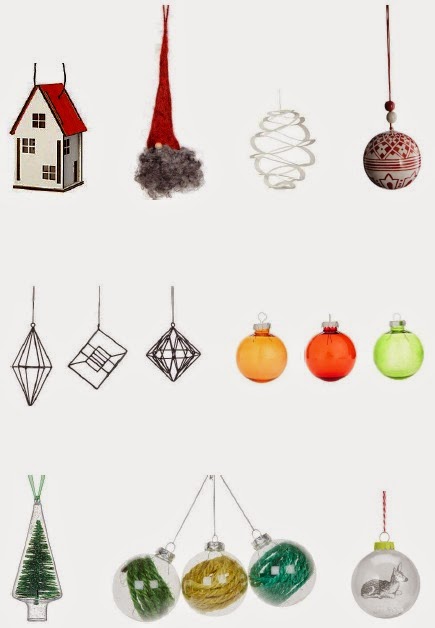
Wooden House Decoration £3 John Lewis, Tomte Grankvist £23 for 3 cloudberryliving.co.uk, Paper Twirl Decorations £14 for 6 Designers Guild, White and Red Bauble £5 Madam Stoltz at Skandium; Geometric Shape Decorations £4 House Doctor at Tate Modern, Multi-Coloured Baubles £8 for 6 Debenhams; Glitter Tree Decoration £3.50 John Lewis, Coloured Jute Baubles £9.99 for 3 Zara, Deer in Snow Glass Bauble £4 Paperchase

So Christmas is nearly upon us again! I for one can hardly believe it, but then I have been very busy at work over the last month and a half, merchandising as many of my pages as possible. 

It was a little hard to know where to start, since every page could do with some attention and there was no way I could see to them all.

Marketing strategy led me to focus on certain seasonally-relevant areas (wintery products, products that make good gifts, products that lend themselves to celebrations). I definitely did my best to look after key Christmassy pages.

At the same time, I didn't want to neglect other important departments just because this isn't meant to be their time of year. So I identified pages with potential and spent time working on them too. I also tried to maintain the pages that were already performing well - you can't let them lose their lustre. 
When selecting these extra sections to merchandise, I was looking for pages that weren't growing commensurately to the website/to their category and for pages that were outstripping average.

There are still whole areas I haven't been able to touch, though I wish I could have.

So it's been very much a matter of splitting myself and not spending too long on one thing.

And on that note, I should probably get on with some of my own Christmas preparation. Presents to buy, cards to write, outfits to pick, meals to plan - oh, how I love Christmas!

Saturday, 27 September 2014

Unexpected way(s) of working

Rag & Bone Cashmere and Wool-Blend Cardigan £330, Hoss Intropia Zebra Brooch £41, Bunney Silver Initial Brooch £195, H&M Short Cardigan £9.99, Uniqlo +J Stretch Cashmere Cardigan £129, Marni Brooch £180, Cilea Brooch at V&A £85, Mango Cotton Cardigan £29.99

I’ve been working with a couple of different strategies when I've been merchandising recently. I had expected to use one, namely figures. I thought it would be a matter of identifying the best products – from the point of view of sales, or profit, or clicks, or any other criterion – and placing them in prominent positions.
However, most pages, I am finding, require a secondary strategy, or logic. It’s like structuring an argument, or an essay, or an article (I think it could be most like constructing an article). You might want to put all your winning ideas at the very beginning, but you have to order them, group them, link them, set each one to its best advantage.
It is necessary to adopt a subsidiary strategy: to use style to determine position, as well as sales, for example; or to consider colour, or function, or price. If I were working on a jewellery page, I might rank my products according to the number of clicks they received, then I might place the top three necklaces on the first row, the top three bracelets on the second, the top three earrings on the third, etc. 
I think the order the functions come in (necklace, then bracelet, then earrings) should be determined by individual product clicks (i.e. if the product to receive the most clicks were a necklace, it should lead and two other necklaces should follow it; if the product to receive the second most clicks were a bracelet, it would then come fourth), rather than overall function clicks (i.e. if bracelets receive the most clicks overall, they would lead). If you don’t heed the individual, you might end up with your best products some distance down the page, if for instance you have one or two very strong necklaces and lots of mediocre bracelets.

Now, I think I am feeling the need to use several strategies because it makes the page easier to understand and more convincing. You might have exactly what the customer wants, it might be at the top of the page, but if it is surrounded by dissimilar products, by products the customer doesn’t want at all, it is easily missed. Using several strategies allows you to break your page into sections, so that the customer can see the extent of your range, discard the parts that are not of interest, and focus on the parts that are. A multi-strategy approach improves the page aesthetic, something that must not be underestimated.

So, from now, on I’ll be seeing more in my products than just their figures!

Sunday, 31 August 2014

And fresh p-p-pages


Muuto (at nest.co.uk) Wood Table Lamp £135, Hay (at nest) Colour Domino Set £39, French Connection Tray Coffee Table £190, Next Bamboo Vase £25, H&M Wood Tray £14.99

Last week, I started properly merchandising in my new position. 

A small professional re-orientation means I'm now working on e-commerce, so - in some respects - my efforts will effect customers more directly and their efficacy will be more immediately measurable.


I can't expect any really reflective results from the pages I've worked on for four to five weeks. But I've been checking them compulsively over the weekend (nothing should have changed, but I couldn't stop myself!) 

And I'm very excited (and simultaneously a bit anxious) to see initial sales tomorrow.

I'd like to compare sales since to sales before I remerchandised. But I will check sales overall, and sales of similar products, for the same periods - because your figures natually fluctuate.

 I could compare this year's sales before and after my merchandising to last year's sales for the equivalent periods. And I could look at actual and forecasted sales for the days after I merchandised.

This should tell me if its starting off on the right foot anyway. Exciting!

Tuesday, 22 April 2014

I recently read an article about a high-street brand that is giving its stores access to live sales data - so that they have visibility of best-sellers elsewhere, can ask other stores who they're selling what to perhaps, and maximise their own potential.

I was thinking of ways to achieve something similar, without huge investment in IT infrastructure.


Perhaps you could calculate each store's best-sellers each week- by value and by unit, because the little, frequent, or add-on, purchases are important - and distribute to the managers. At the end of each month, you could do the month's best-sellers as well as the week's best sellers and ask managers for a comment - if they've been using any techniques in particular to achieve these sales, etc.

I think this could really stimulate sales. And hopefully the means would be its own metric - if you saw best-sellers spread from store to store, you could see it was having an effect.

The bank holiday weekend gave me a much appreciated rest. At the end of the week, I was reading about an amazing treatment in Lush Spasp - the Hard Day's Night treatment. It's a full-body ,Shaitsu-inspired massage, performed to the sound of some brilliant Beatles covers (you can have a listen, and find more details, here), while you're in really comfortable pyjamas. Afterwards, I believe you are given a cup of tea, a biscuit and a bath bomb.

I tried to recreate something similar at home - lazing around in loungewear, listening to music, having lots of tea and demanding a back rub from my boyfriend. The below paints the picture (glamorised in some aspects, of course!). Hope your weekend has been just as busy or just as relaxing as you wanted.


Equipment Lilian Silk Pyjamas £430, Zimmerli Men's Pyjama Trousers £85, Lush Strawberry Feels Forever Massage Bar £5.75, Lush Blackberry Bath Bomb £2.95, Royal Copenhagen Blue Fluted Plain Cup & Saucer 89€, Pukka Detox Tea, Pink Wafer Biscuits

Monday, 14 April 2014


A while ago, I attended a range review. I helped a little with the preparation: pulling together sales by product last year, both in total and by channel; and then ranking the products, again both by channel and overall. We also produced spreadsheets grouping products by line and category, showing the different categories each family comes in, and calculating top-line growth by category.

The discussion at the range review meeting was fascinating. In many instances, the managers weren’t really wanting to extend or reduce the range; their aim was to replace a slow-seller with a best-seller.  The replacement should therefore please both new customers and stalwarts of the old product – a hard bill to fit!

The categories to which they were wanting to add references were the those showing the highest growth, yes – but also categories comprising disproportionately few SKUS, compared to competitors, and categories where sales were strong and steady (to prevent this sort of category becoming stale, they wanted newness – exciting launches and for the products that are not pulling their weight to be discontinued).

It was really fascinating!

When I looked out of the window this morning, the cherry outside had blossomed dawn-pink. And this was set against the sunset-orange flowers of the shrub beneath. It was so striking I had to take the picture above. And in many ways, the prints in store at the moment reflect these clashing florals. I think the below are particularly beautiful:


Floral Patchwork Print Dress Markus Lupfer £315, Botanical Print Dress Warehouse £65, Shard Rose Print Dress Paul Smith £320, Wisteria & Violet Cologne Alex Monroe £82, Hand Decorated Easter Eggs Fortnum & Mason from £39.95 each

Tuesday, 1 April 2014

For various reasons, my manager recently asked me to compare this month's sales to this month last year's sales, for active SKUs alone.

First, I ran a report for each period and formatted the hellish mess out of them (our EPOS generates some pretty cluttered reports!) Then I reinserted products that have been deleted and are no longer recognised. I compiled both reports and removed the duplicates (to get one comprehensive list of all products sold). I sorted by a part of the product code, to separate out the categories. Finally I vlooked-up (or vlookuped?) status and sorted discontinued/newly-launched product to the bottom.

When it was looking a bit better, I pulled in the sales by value and by unit for 2013 and 2014. After this, I calculated the % difference (by value and by unit) for each product, the % difference by category, and the % difference by category taking into account only active products (it was the last one we were really interested in). To finish, I calculated % difference across all products and across all active products.

What I found was really useful and really positive: strong growth, particularly in active SKUs. And my manager has asked me to do this every month going forward - no small task, but I am pretty proud to have devised a report he appreciates.

Last post, I pulled together some 'botanical illustration' floral prints. I'm not branching out too much this week - I've focussed on floral pencil-drawing prints. Hope you like:


Esprit Printed Cotton Trousers £55, Uniqlo Modal Linen Blended T-Shirt £9.90, Alexander Wang Patent-Leather Loafers £565, Miller Harris Fleur du Matin from £65, Diptyque Rich Body Butter £50, Cowshed Knackered Cow Relaxing Body Lotion £18, Sanderson Anise Wallpaper from £46, Cole and Son Frontier Water Lily Wallpaper from £72